2025
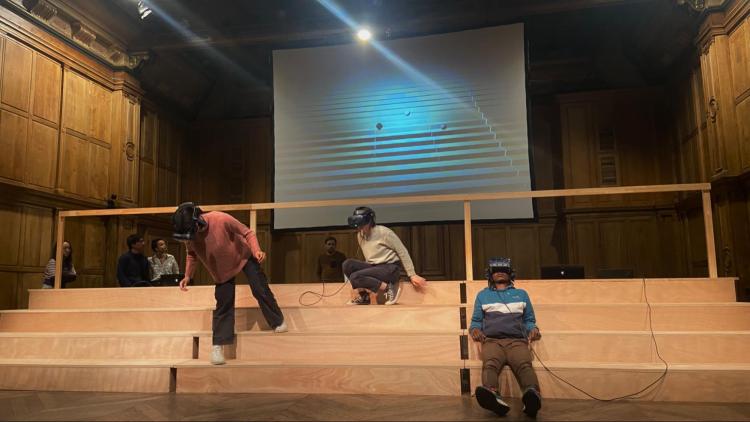
Rythmes(s) d’espaces 2 : Variations sur l’usage de la réalité virtuelle pour la mise en scène
Né d’une rencontre dans le cadre du programme doctoral SACRe de l’Université PSL, le projet de recherche-création Rythme(s) d’espaces explore l’hybridation de scénographies réelles et virtuelles comme un outil et une nouvelle méthode de mise en scène. À travers une série de workshops interdisciplinaires et de représentations à la lisière entre danse et théâtre, nous étudions comment différentes caractéristiques dynamiques des espaces virtuels mobilisent les corps performant, pour l’émergence de rythmes individuels et d’un rythme global. En explorant des questions communes et individuelles, ce projet collaboratif est le terrain de développement de techniques favorisant l’usage des technologies immersives comme un endroit de dialogue entre metteur•ses en scène, interprètes et public.
Rémi Sagot-Duvauroux, Vivianna Chiotini. Rythmes(s) d’espaces 2 : Variations sur l’usage de la réalité virtuelle pour la mise en scène. Journées d’informatique théâtrale, Oct 2024, Avignon, France. ⟨hal-05138760⟩
2023
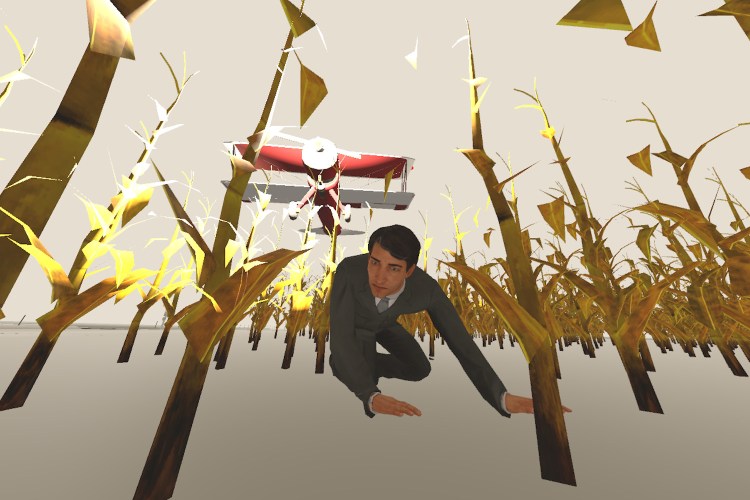
The Hitchcock Experience – a Spatial Montage project
This paper describes an ongoing art project exploring the generalization of classical montage theory to the emerging technology of “room scale VR”. We take the emblematic “crop duster” scene in Alfred Hitchcock’s North by Northwest and invite the spectator to experience it “from the inside”. This raises interesting research issues. How to inhabit this cinematic story world? How can the traditional tools of cinematography and montage be used to direct the audience in this new kind of experience? How can the rhythm of the spectator’s body be matched to the rhythm of George Tomasini’s (Hitchcock’s editor) fast pace editing? And what form can this montage take and for what aesthetic and dramaturgical effects? To answer these questions, we propose the experiment of a montage that adapts in real time to the displacements of the body and the gaze of the spectator, engaging a dialectic between narrative rhythm and bodily rhythm. We propose new algorithmic tools to transport the audience into the story as originally planned by Hitchcock while at the same time respecting the behaviors of the audience to guide the experience. In doing so, we seek to create a new form of relationship between the author of a narrative experience in virtual reality and the spectator who explores and activates the experience with his own body.
Sagot-Duvauroux, Rémi, Nils Quaetaert, François Garnier, et Rémi Ronfard. « The Hitchcock Experience – a Spatial Montage project ». International Symposium on Electronic Art (ISEA), Paris, France, Mai 2023

Feeling One’s Way: In Search of a Symbiotic Vocabulary of the Virtual
This article aims to present the collective research that has been made in the framework of the research seminar « Vocabulary of the Virtual » organized by IRCAV (Institute of Research on Cinema and Audiovisual Studies), Sorbonne Nouvelle and the “Spatial Media” group, EnsadLab. The main topic is to clarify the notions that refer to the concept of the « Virtual » in order to define it through an interdisciplinary approach according to different fields of science (aesthetics, philosophy, film theory, sound theory, ergonomics, design, engineering, cognitive sciences, etc.). This article presents many different conceptual tools such as cartography, mental maps, notional diagrams with several dimensions, etc., that have been conceived over the last three years, to show how the reflection on the concept of the Virtual was first established and constructed, and how it has been developed. The notion of symbiosis seems to be defined as a structuring notion of the concept of the Virtual across the process of anchoring the levels of virtuality inside technological devices and concrete sites, as well as inside the physical body of the VR users. The user’s body serves as a catalyst for the concept of the Virtual which then becomes organic.
Kobryn, Olga, Matthieu Couteau, Rémi Sagot-Duvauroux, Sophie Balcon-Fourmaux, François Garnier, Rémi Ronfard, et Guillaume Soulez. « Feeling One’s Way: In Search of a Symbiotic Vocabulary of the Virtual ». International Symposium on Electronic Art (ISEA), Paris, France, Mai 2023.
2022

Rythme(s) d’espaces 1 : Etude sur l’usage de la réalité virtuelle pour la mise en scène
Ce projet interdisciplinaire de recherche-création explore l’émergence de nouvelles expériences de scénographie grâce à l’hybridation de décors réels et d’environnements virtuels orientant les mouvements des interprètes. Basé sur une série d’expérimentations avec deux danseuses et un danseur dans le cadre d’une performance en triptyque, nous explorons différentes caractéristiques dynamiques des espaces virtuels et leurs influences sur la mise en scène créée. Nous y étudions l’équilibre entre contraintes et libertés, entre contemplation et interactivité et nous développons des outils favorisant l’usage des technologies immersives comme un endroit de dialogue entre scénographe, interprètes et public. Nous proposons dans cette contribution de définir le contexte dans lequel nous nous inscrivons, de décrire notre processus artistique expérimental et d’ouvrir sur nos futures explorations.
Sagot-Duvauroux, Rémi, et Vivianna Chiotini. « Rythme(s) d’espaces 1 : étude sur l’usage de la réalité virtuelle pour la mise en scène ». JIT 2022 – Journées d’Informatique Théâtrale, Inria Grenoble Rhône Alpes; ENSATT Lyon; Laboratoire Passages XX-XXI de l’Université Lyon 2, Octobre 2022, Lyon, France.

Montage as a narrative vector for virtual reality experiences
The goal of our paper is to demonstrate through artistic experimentation that the concept of montage can be an effective vector for conveying complex narratives in immersive, room-scale virtual reality experiences. We review the particularities of virtual reality mediations regarding narrative, and we propose the new conceptual framework of « spatial montage » inspired by traditional cinematographic montage, taking into account the specific needs of virtual reality. We make the hypothesis that spatial montage needs to be related to body action of the user and can play a significant role in relating the immersive experience with an externally authored narrative.
Sagot-Duvauroux, Rémi, Rémi Ronfard, et François Garnier. « Montage as a narrative vector for virtual reality experiences ». ConVRgence (VRIC) Virtual Reality International Conference Proceedings, International Journal of Virtual Reality, 2022.

(Re-)Framing Virtual Reality
We address the problem of translating the rich vocabulary of cinematographic shots elaborated in classic films for use in virtual reality. Using a classic scene from Alfred Hitchcock’s « North by Northwest », we describe a series of artistic experiments attempting to enter « inside the movie » in various conditions and report on the challenges facing the film director in this task. For the case of room-scale VR, we suggest that the absence of the visual frame of the screen can be usefully replaced by a scaled, spatialized and oriented zone in which the subject acquires a limited walking and acting area. This « re-framing » opens new directions for creative film directing and editing in virtual reality.
Sagot-Duvauroux, Rémi, François Garnier, et Rémi Ronfard. « (Re-)Framing Virtual Reality ». WICED 2022 – 10th Workshop on Intelligent Cinematography and Editing, The Eurographics Association, Avril 2022.
2021
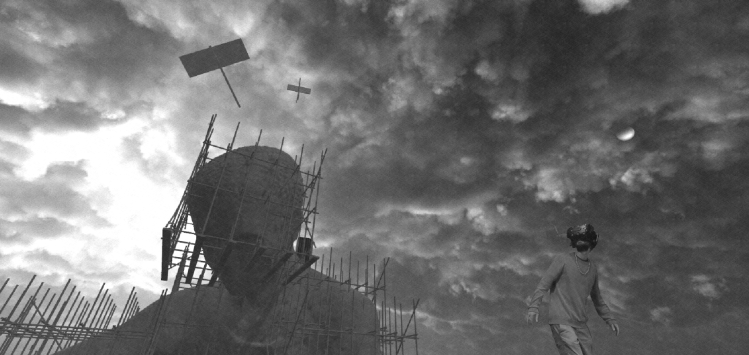
Immersant·e et créateur·rice en présence
Qu’il soit spectatoriel, fictionnel, ludique ou fonctionnel, un contrat tacite définit le statut et le rôle de chacun·e dans la lecture d’une œuvre et participe à l’émergence de la forme et de la nature de la médiation. Les dispositifs de réalité virtuelle permettent une activité sensorimotrice et cognitive dans une simulation numérique pouvant être l’espace de représentation d’une diégèse. Même si un environnement virtuel est imaginé, modélisé et codé préalablement par un·e créateur·rice, il ne peut exister qu’à travers son actualisation par un·e « immersant·e » : une personne immergée dans un espace numérique dont le statut dépend du lien qu’il·elle va créer avec l’œuvre tout au long de l’expérience.
Sagot-Duvauroux, Rémi. « Immersant·e et créateur·rice en présence ». Héro·ïne·s – Repenser les héros dans les œuvres et pratiques artistiques, avec le groupe de recherche de La Fémis, réalisée au sein du programme « Sciences, Arts, Création, Recherche » (SACRe, PSL).
 Dr. Rémi Sagot-Duvauroux